I Am King

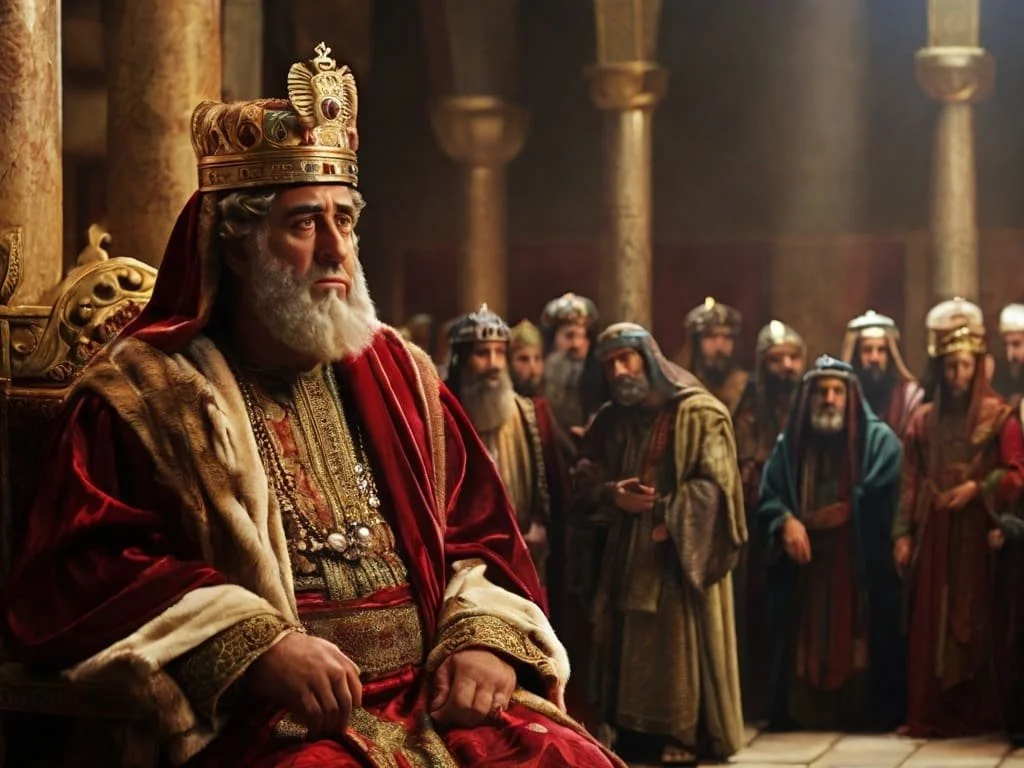
The following is a first-person narrative written from the perspective of Herod the Great based on Matthew 2:1-21. While it is in part a work of imaginative Bible reading, it is true to the historical facts known about Herod the Great, a notoriously cruel and paranoid ruler who stopped at nothing to protect his own power.

I have been called many things: cunning, cruel, brilliant, lucky. I own them all. But there is one word I savor most: king.

Sweeter than honey is the sound of this word next to my name: King Herod.

Lest you think I was born with a silver spoon in my mouth, history shows otherwise. I was born a commoner like all of you, and I fought my way to the top.

I am a winner.

Although many have tried to snatch my kingship from me—there have been assassination plots, coups, rivalries—I have always outfoxed my enemies. It is an unfortunate business, but sometimes even wives and sons need to be eliminated. A man like me cannot be too careful.

If it has been necessary to get blood on my hands, surely I have done enough to wash them clean.

Am I not the great patron of our faith, who rebuilt the temple in Jerusalem, the pride of the Jews and the envy of the Gentiles? How many oxen and sheep have been sacrificed on those hallowed altars due to my benevolence? How many prayers have risen to heaven on my behalf? Surely no man has done more for God than I.

Yes, I allow God his rightful place. As long as he allows me mine.

My vindication is this: against all odds I reigned for 33 years, a feat that few can boast.


But there was one threat to my throne that I was unable to eradicate.

It began one day in the twilight of my reign when royal emissaries from the east, Magi, arrived at my palace. They were dressed in finer robes than mine, and came with an impressive retinue of servants. These unexpected guests troubled us by asking, “Where is he who has been born king of the Jews? We saw his star when it rose and have come to worship him.”

Did my ears deceive me? Or were these men uninformed that the title “King of the Jews” was rightfully mine, granted by the Roman Senate and certified by the hand of Caesar himself?

It is beyond my comprehension why Magi from the East would willingly come and bow down to a Jewish infant. In this world where so many are eager to take away your power and treasure, why give it freely? 

The smell of some treachery filled my nostrils. I knew what I had to do, and I did it quickly.

First I sent away the Magi. Then I sought council with the chief priests and learned men of Israel, to see if some prophecy in the Scriptures could locate this new king. For surely anyone born a king must be one called Messiah. These gray-headed men searched the scrolls and found their answer.

“In the village of Bethlehem” they said, quoting from some prophet or another, “for out of you will come a ruler who will shepherd my people Israel.”

I had the information I needed. Sending them away, I then called the Magi in secret to find out exactly when the star had appeared. “Two years ago” they said. My stomach turned within me. All this time, right under my nose!

“The child you seek is in Bethlehem,” I told them. “Now go—search carefully for him and quickly report back to me so that I too may go and worship him.”

And so they trotted off, acting as my unwitting informants.

Days passed. My appetite left me. I trusted no one.

Finally, a messenger came into my chambers. He was trembling.

“I bring news, oh King” he said. “And I beg your mercy when I tell it.”

“Out with it!” I said. “What of the Magi? What do they report?”

“Your highness,” He croaked, “only that the Magi were spotted yesterday returning east by another road. Your spies came with the word and I have run to tell you.”

I threw my wine goblet across the room.

I should have known they would deceive me!

But when diplomacy fails, there is always the sharp edge of the sword.

I ordered my royal guard to go and kill all boys in the vicinity of Bethlehem two years old and younger, which they did. Spare your tears; there could not have been more than a few dozen that fit this description, and they were all peasants. Many would have died before reaching maturity anyway.

I think you will agree that it was the only thing I could have done to stamp out this imminent threat.

I died soon after these events, but at least went to my grave with my reputation and pride intact. I was not so foolish as to surrender that title king to another, and no man was able to pry it from my hands.

So why do I bother to tell you this story now? I speak from beyond the grave to warn you. This baby they call the Christ may appear harmless. I see they have even made a holiday called “Christmas” that is supposedly about love and cheer. But do not be fooled!

My instincts were correct. This one they call the Christ was a threat to my power—and a threat to any who want to remain in control of their lives.

From my place among the dead I have seen the madness of this story. How this so-called Christ lived in poverty and had no throne or palace. How he associated not with royalty but with riff-raff. How he never gained power but in fact was crucified, the most spectacular failure imaginable. And yet millions have bowed the knee and thrown away their lives for this pathetic excuse for a king. The Magi were the first to follow this foolish course.

And so I warn you. If you desire to remain the master of your own destiny, you must not cede an inch of ground to this one they call the Christ.

If you resist, I promise you this: You may not have a vast domain like I did. Yours may only be the domain of your own four walls, your own family, your own self. But at least you can lay your head on your pillow at night and say these words: “I am king.”


Family Tree. Recommended Resources for Further Study

Books:

Church History in Plain Language by Bruce Shelley (Zondervan, 2021)

Bullies and Saints: An Honest Look at the Good and Evil of Christian History by John Dickson (Zondervan, 2021)

Why the Reformation Still Matters by Michael Reeves and Tim Chester (Crossway, 2016)

What it Means to be Protestant by Gavin Ortlund (Zondervan, 2024)

Who is an Evangelical? The History of a Movement in Crisis by Thomas Kidd (Yale University Press, 2019)

The American Evangelical Story by Douglas Sweeney (Baker, 2005)


Online Resources:

Gavin Ortlund / Truth Unites – YouTube Channel

The Center for Baptist Renewal – centerforbaptistrenewal.com

Podcast: 5-minutes in Church History with Stephen Nichols

Lausanne Congress on World Evangelization – congress.lausanne.org

Family Tree 9. "Ten Generations: Georgia Plains Baptist Church (1793 – present)"

9. Ten Generations: Georgia Plains Baptist Church (1793 – present)

Our church has its own place on the Christian family tree. It is an outgrowth of the Baptist movement and the second Great Awakening. On October 12th, 1793, the Baptists in Georgia covenanted together to form a church (13 men, 4 women, and their families). They met in log cabins “crowded as full of people as could be crammed.” Their first settled pastor was Roswell Mears from 1807-1825, who did much to lay the foundation of the church. After many years sharing the town hall with Congregationalists, the Baptists purchased land and built their own meeting house in its current location in 1848. The first building was destroyed by fire in 1886, and a new building was dedicated exactly one year later. Over the years, our church has weathered the Civil War, world wars, economic collapses, pandemics, population changes, theological controversies, and the rapid changes of the modern world. It has experienced seasons of revival and seasons of drought. Our pastors have included Alvah Sabin, who also served in the US Congress and worked in the abolition movement, Grace Brooks, the first female pastor ordained in Vermont who served from 1919-1947, and Henry Suld, an Estonian refugee from WWII who escaped his German captors and trained for ministry in Stockholm. We have been aligned with both the mainline church tradition and the Evangelical movement, with several recent pastors coming from Evangelical seminaries. Through the leadership of many faithful pastors, the gifts and labors of so many church members, and above all the grace of God, we have for 232 years –about ten generations—maintained a gospel witness in Georgia, Vermont. May it continue until Jesus returns.

Scripture: Psalm 145

People: Roswell Mears, Alvah Sabin (1793-1885), Joseph Lorimer, Grace Brooks, YOU

“During Eld. Mears pastoral care of the church [1807-1825], God’s people were instructed from his holy word, may sinners were convicted and converted. Elder Mears possessed a peculiar faculty for religious consolation and pastoral duty and was universally respected and beloved.” – From an 1879 report

“The year 1816 was a year of the right hand of the most high, a large number were added to the church, prominent among these were those who afterward occupied “the high places of the filed” viz: Daniel Sabin, Joseph Ballard and Alvah Sabin who have spent their life in the ministry of the word.” – From an 1879 report  

“The pews were never rented, but free to all comers.”[1] – Alvah Hobart, describing the church in the mid-1800s.

 “In 1837 came the great financial panic. …the failure of the wheat crop, the removal of the deposits of public moneys from the United States Bank, one of the most disastrous and widespread panics swept over the country. Following this came a great revival of religion. As men saw their worldly goods vanish, they turned with a new interest toward the riches ‘which moth doth not corrupt nor thieves break through and steal.’” [2] – Alvah Sabin

Alvah Sabin, beloved pastor from 1828 - 1876

“Our forefathers did not fail in the task that was given unto them. Dare we not. We are living in serious times. Each of us has a contribution to make. God demands that we should be a vital witness in this community—realizing more fully our missions and purpose as a church which belongs to the Universal Church of Christ. Only by the grace of God can we accomplish this endeavor. May God Almighty help us!”  – Rev. Richard Seeley, October 25, 1962

Joseph Lorimer, pastor from 1877-1902. Born in Quebec, Lorimer grew up in Derby before coming to serve in Georgia. His wife, Myra Hale, had been raised in our church. The Lorimers were the first occupants of current parsonage, built in 1876.   

Application: Thank God for those who have held the torch before us. Pray for our church and serve our church. We need you.


[1] Life of Rev. Alvah Sabin, Alvah S. Hobart (The Review Printing Company, 1885), p. 94

[2] Quoted in Life of Rev. Alvah Sabin, Alvah S. Hobart (The Review Printing Company, 1885), p. 68.

Family Tree 8. "Gospel People: The Modern Evangelical Movement (1925 – present)"

8. Gospel People: The Modern Evangelical Movement (1925 – present)

With roots in the Great Awakenings, the modern Evangelical Movement emerged in the 1930s as a third way between theological liberalism and strict fundamentalism. The word “evangelical” is from the Greek word euangelion, meaning “good news” or “gospel.” Evangelicalism is not a denomination, but a network of like-minded people from across many denominations. It’s a big-tent Christianity that brings together different kinds of Christians with these four commitments:[1]

1.      Conversion – “You must be born again.”

2.      Scripture – the Bible is the authoritative, infallible Word of God.

3.      The Cross – the heart of the gospel is Jesus’ atoning death on the cross.

4.      Activism – the gospel must be shared in word and deed.

Evangelicalism is now a global movement that has been a driving force for missions, church planting, and social action around the world.

In addition, the Evangelical movement has a rich tradition of biblical scholarship and intellectual activity. It has given birth to many seminaries, colleges, book publishers, and magazines.   

Scripture: John 3:16-18; 1 Corinthians 15:1-6

People: Billy Graham (1918-2018), Carl F. Henry (1913-2003), John Stott (1921-2011), Henrietta Mears (1890-1963), John Perkins (1930 -)

“Christianity is by no means the social gospel of modernism, but is nonetheless vibrant with social implications as a religion of redemptive transformation.”[2] – Carl F.H. Henry

“God proved His love on the Cross. When Christ hung, and bled, and died, it was God saying to the world, 'I love you.” ― Billy Graham

Billy Graham

“Make the Bible your source and your authority. Quote it frequently. Let its message be your message. Study it, meditate upon it, memorize it. Trust its promises. The Word of God itself has power.”[3]    – Billy Graham


“It is our duty to do all we can to introduce every generation to Christ.”[4] -Henrietta Mears

“Every Christian should be both conservative and radical; conservative in preserving the faith and radical in applying it.” – John Stott

“For too long, many in the Church have argued that unity in the body of Christ across ethnic and class lines is a separate issue from the gospel. There has been the suggestion that we can be reconciled to God without being reconciled to our brothers and sisters in Christ. Scripture doesn’t bear that out.” – John Perkins


Application: Look back at the four commitments that define the Evangelical movement. Are you committed to these things? Is there anything you would add?  


[1] This idea comes from historian David Bebbington

[2] Carl F.H. Henry, “Dare We Renew the Controversy?” in Keith J. Hardman, ed. Issues in American Christianity: Primary Sources with Introductions (Grand Rapids: Baker, 1993), 282.

[3] Quoted in video “Honoring Billy Graham,” (https://billygrahamlibrary.org/photos-videos/honoring-billy-graham/) Accessed 5/22/2025.

[4] Dr. Henrietta C. Mears (2016). “Sunday School Changes Everything”, NavPress, p. 15.

Family Tree 7." A Surprising Work of God: The Great Awakenings (1730s – 1830s)"

7. A Surprising Work of God: The Great Awakenings (1730s – 1830s)

God has often sustained his church by sending periods of spiritual revival. Two of these periods in the English-speaking world were the 1730s-40s and the 1790s-1830s. These widespread revivals brought explosive growth to Christianity, new cooperation between denominations, and the formation of mission boards to send missionaries to unreached countries. Revival also contributed greatly to social reform, fueling anti-slavery societies, poverty relief, education, labor laws, and many other causes.

Scripture: Acts 2:14-24, 36-41

People: John Wesley (1703-1791), George Whitefield (1714-1770), Jonathan Edwards (1703-1758), Peter Cartwright (1785-1872), Jeffrey Brace (1742-1827), Pheobe Palmer (1807–1874).  

Events: Northampton Revivals (1734-42), Cane Ridge Revival (1801), American Bible Society founded (1816)

 “[T]he Spirit of God began extraordinarily to set in, and wonderfully to work amongst us… There was scarcely a single person in the town, old or young, left unconcerned about the great things of the eternal world. …. And the work of conversion was carried on in a most astonishing manner, and increased more and more; souls did as it were come by flocks to Jesus Christ. … This work of God, as it was carried on, and the number of true saints multiplied, soon made a glorious alteration in the town: so that in the spring and summer following, anno 1735, the town seemed to be full of the presence of God…”[1]                                –Jonathan Edwards, describing the beginning of the Northampton
Revival

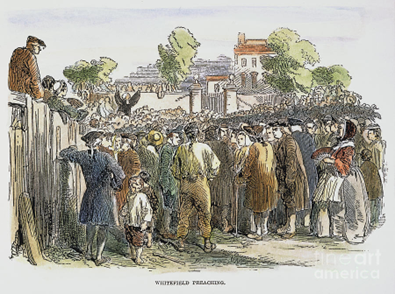
George Whitefield Preaching to a large crowd. During his ministry, an estimated 10 million people heard him preach. One eyewitness wrote, “Our mechanics shut up their shops, and the day-laborers throw down their tools, to go hear him preach, and few return unaffected… He speaks from a heart all aglow with love, and pours out a torrent of eloquence which is almost irresistible.”


 “About a quarter before nine, while he was describing the change which God works in the heart through faith in Christ, I felt my heart strangely warmed. I felt I did trust in Christ, Christ alone, for salvation; and an assurance was given me that He had taken away my sins, even mine, and saved me from the law of sin and death.”[2] – John Wesley, describing his conversion on May 24th, 1738 The Journal of John Wesley

“God forbid that I should travel with anybody a quarter of an hour without speaking of Christ to them.” – George Whitefield, Selected Sermons

“John Wesley tells of a dream he had. In the dream, he was ushered to the gates of Hell. There he asked, "Are there any Presbyterians here?" "Yes!", came the answer. Then he asked, "Are there any Baptists? Any Episcopalians? Any Methodists?" The answer was Yes! each time. Much distressed, Wesley was then ushered to the gates of Heaven. There he asked the same question, and the answer was No! "No?" To this, Wesley asked, "Who then is inside?" The answer came back, "There are only Christians here."”George Whitefield, source unknown


Application: Pray for revival in your own heart, in our church, and the church at large.


[1] Jonathan Edwards, A Faithful Narrative of the Surprising Work of God, 1736. Quoted from <https://www.jonathan-edwards.org/Narrative.html> Accessed 5/18/25

[2] Quoted from <https://www.christianity.com/church/church-history/timeline/1701-1800/john-wesleys-heart-strangely-warmed-11630227.html> Accessed 5/18/25

Family Tree 6. "Champions of Freedom: The Baptist Movement (1600 – 1800)"

6. Champions of Freedom: The Baptist Movement (1600 – 1800)

Beginning in the early 1600s in England, some wanted to take the ideas of the Protestant Reformation father. They sought a purer, more biblical church, marked by believer’s baptism (as opposed to infant baptism) and free from the state government. Although begun in England, the Baptist movement took hold and spread in the American colonies despite opposition from other Christian groups. The first Baptist church in America was founded in Providence in 1638. After American independence, Baptists were strong supporters of religious freedom, championing the First Amendment.

Scripture: Matthew 22:15-21; Galatians 5:1,13

People: John Smyth (c. 1554-1612), Thomas Helwys (c. 1575-1616), Roger Williams (1603-1683), John Leland (1754-1841)

Concepts: Believer’s baptism, religious liberty, separation of church and state

18th century baptism service

“The magistrate is not by virtue of his office to meddle with religion, or matters of conscience, to force or compel anyone to this or that form of religion or doctrine, but to leave the Christian religion free to everyone's conscience, and handle only civil transgressions, for Christ only is the King and lawgiver of the church and conscience.” – John Smyth, first English Baptist

“…God requireth not an uniformity of Religion to be inacted and inforced in any civill state; which inforced uniformity (sooner or later) is the greatest occasion of Civill Warre, ravishing of conscience, persecution of Christ Jesus his servants, and of the hypocrisie and destruction of millions of souls.”[1] – Roger Williams

“That cannot be a true religion which needs carnal weapons to uphold it.” – Roger Williams

“Men's consciences ought in no sort to be violated, urged, or constrained.” – Roger Williams

“[The 1780s] was a time of great zeal, prayer, and effort, and the blessing of God descended in great power upon the struggling Baptist communities of the Green Mountain State. The Baptists suffered severely from the tyranny of the "standing order" at this period in Vermont, and it was only after years of persistent labor that the disabilities under which they groaned were removed, and the complete separation of Church and State was accomplished.”[2]            – A Baptist Encyclopedia published in 1881

Application: “Christian Nationalism” is a fast-growing ideology that seeks to impose its own version of the faith through government power. Not only does this threaten our democracy, but it perverts the gospel. Learn to recognize it and, as a Christian, speak out against it.


[1] Roger Williams, “The Bloudy Tenent of Persecution.” Quoted in Keith J. Hardman, ed. Issues in American Christianity: Primary Sources with Introductions (Grand Rapids: Baker, 1993), 32.

[2] The Baptist Encyclopedia, 1881. <http://baptisthistoryhomepage.com/vermont.baptists.tbe.html> Accessed 5/4/25.

Family Tree 5. "Recovering the Gospel: Martin Luther and the Protestant Reformation (1500s)"

5. Recovering the Gospel: Martin Luther and the Protestant Reformation (1500s)

The Roman Catholic Church of the Middle Ages had buried the gospel of salvation by faith under centuries of traditions, unbiblical teachings, and institutional buildup. One of the most egregious examples was the prolific sale of indulgences, papers given in the name of the Pope that were said to reduce time in purgatory. Starting with Martin Luther, through the tumultuous period of the Reformation the simple gospel of justification by faith in Jesus was recovered and re-centered in the Protestant movement.

Scripture: Romans 1:17; 3:21-26; Ephesians 2:1-10

People: Martin Luther (1483-1546), John Calvin (1509-1564), Thomas Cranmer (1489-1556)

Concepts: Justification by Faith, Sola Scriptura

“Night and day I pondered…Then I grasped that the justice of God is that righteousness by which, through grace and sheer mercy, God justifies us through faith. Thereupon I felt myself to be reborn and to have gone through open doors into paradise.”[1] – Martin Luther, after wrestling with Romans 1:17

“We do not become righteous by doing righteous deeds, but by having been made righteous, we do righteous deeds.”[2] – Martin Luther

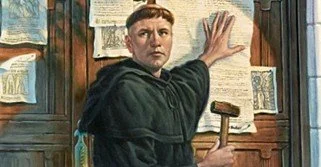
Martin Luther nails his 95 Theses to the door of the church in Wittenberg, protesting the sale of indulgences, October 31st, 1517

“Justification is the main hinge on which salvation turns.” – John Calvin

 “In the midst of life we are in death, earth to earth, ashes to ashes, dust to dust, in sure and certain hope of the Resurrection.” – Thomas Cranmer


Application question: When you arrive at the gates of heaven, why should you be let in?


[1] Ibid.

[2] Michael Reeves and Tim Chester, Why the Reformation Still Matters (Wheaton: Crossway, 2016) p?

Family Tree 4. "The Word of God for the People of God: Bible Translation Efforts in the Pre-Reformation (1300 – 1540)"

4. The Word of God for the People of God: Bible Translation Efforts in the Pre-Reformation (1300 – 1540)

In the Late Middle Ages, many began protesting the corruption of the Roman Catholic Church, calling for both moral and theological reform. During this time, the Bible was inaccessible to the vast majority of Christians and only read at the mass in Latin. The church actively discouraged Bible translation and persecuted those who attempted to do so, and yet many gave their lives for this cause.

Scripture: Nehemiah 8:1-8; Romans 10:12-17

People: John Wycliffe (c. 1328-1384), Jan Hus (c. 1369-1415), William Tyndale (c. 1494-1536)

 “The truth of God standeth not in one language more than in another…[An English Bible] may edify the lewd people as it doth clerks in Latin…Why man we not write in English the gospel and other things dedicating the gospel to the edification of men’s souls?”[1]              – John Wycliffe

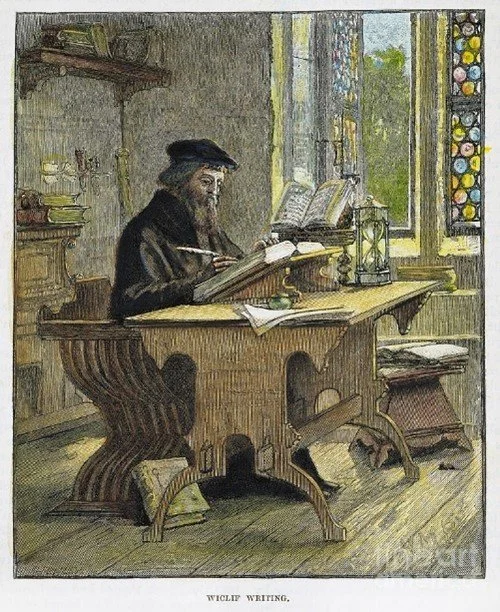
John Wycliffe, “Morning star of the Reformation”

“Truth conquers.”[2] – Jan Hus

“If God spares my life, ere many years, I will cause the boy that driveth the plow to know more of the Scriptures than thou dost!” -William Tyndale, responding to the criticisms of an educated clergyman


Application:

We are so blessed to have access to the Bible in our own language. Read it! Also, consider supporting translation efforts through organizations like Wycliffe Bible Translators, so that all people can have the Bible in their mother tongue.


[1] Quoted in video, “William Tyndale’s Death is Not What You’ve been Told” by Gavin Ortlund. <https://www.youtube.com/watch?v=2DetuTE_XCo&t=798s> Accessed 4/24/25.

[2] Quoted from <https://www.christianity.com/wiki/people/the-tragic-trial-and-death-of-jan-hus-11633059.html> Accessed 5/27/25.

Family Tree 3. "Lights in the Middle Ages: The Monastic Movement (500 – 1300)"

3. Lights in the Middle Ages: The Monastic Movement (500 – 1300)

In 530, Benedict of Nursia created a template for monastic life centered around prayer, work, and communal living, that served as the basis for over 37,000 Benedictine monasteries across Europe and inspired many other monastic orders. Throughout the “dark ages,” these monastic communities preserved and advanced the faith. Monks evangelized Europe and meticulously copied the Bible. In addition, Monasteries built culture: they were centers of education, agriculture, trade, and technological innovation.

Scripture: Mark 12:30-31; 1 Corinthians 9:24-27

People: Benedict of Nursia (480-547), Alciun of York (735-804), Anselm of Canterbury (1033-1109)

Benedict of Nursia

“The good of all concerned, however, may prompt us to a little strictness in order to amend faults and to safeguard love.[1] – From The Rule of St. Benedict

“The love of Christ must come before all else.”[2] – From The Rule of St. Benedict


“O Lord our God,

grant us grace to desire you with our whole heart,

that so desiring we may seek and find you;

and so finding you we may love you;

and loving you we may hate those sins

from which you have redeemed us;

for the sake of Jesus Christ.”[3]

– Anselm of Canterbury

Monks at work

“Monks for more than a thousand years sustained what was most noble and most Christ-centered in the church.”[4] – Mark Noll


Application:

How can our church be an outpost of the gospel in our own “dark ages” of loneliness, addiction, despair, and spiritual poverty?


[1] Timothy Fry, Ed. The Rule of St. Benedict in English (Liturgical Press, Collegeville, MN, 1980), 18.

[2] Ibid, 12.

[3] https://acollectionofprayers.com/tag/anselm/page/2/

[4] Mark A. Noll, Turning Points: Decisive Moments in the History of Christianity (Baker, Grand Rapids, 1997), 104.

Family Tree 2. "Athanasius Against the World (300's)"

2. Athanasius Against the World (300s)

After Emperor Constantine granted favored status to Christianity, persecution tapered off. Instead, the church began to face division from within. A popular teacher named Arius held that Jesus was a created being, not the eternal Son of God. As his views gained dominance, one pastor/bishop named Athanasius from Alexandria, Egypt, did much to defend the truth. The Ecumenical Councils of Nicaea in 325 and Constantinople in 381 gave us the Nicene Creed which clearly articulated the full divinity of Jesus Christ. In this period, the church continued to clarify important doctrines like the Trinity and the divine-human natures of Christ.

Scripture: John 1:1-18

People and events: Athanasius of Alexandria (c. 296-373), Council of Nicaea (325), Augustine of Hippo (354-430)

“We believe in one Lord, Jesus Christ,

the only-begotten Son of God,

eternally begotten of the Father,

God from God, Light from Light,

true God from true God,

begotten, not made,

of one Being with the Father;

through him all things were made.

For us and for our salvation he came down from heaven,

was incarnate from the Holy Spirit and the Virgin Mary,

and was made man.”

-From the Nicene Creed


“The results of the incarnation of the Savior are such and so many, that anyone attempting to enumerate them should be compared to a person looking upon the vastness of the sea and attempting to count its waves.”[1] -Athanasius of Alexandria

“For you made us for yourself, and our hearts are restless until they find their rest in you.”[2] – Augustine of Hippo


Application:

Consider what an awesome Savior you have in Jesus. What modern heretical teachings diminish his person or work?


[1] Athanasius, On the Incarnation. Ch. 54. Available at <https://www.newadvent.org/fathers/2802.htm> Accessed 5/27/25.

[2]Augustine, Confessions. 1.1